Lincoln's Last Best Hope: Civil War Ties to 1776 Declaration Ideals
By Roy Kaden on January 28, 2026
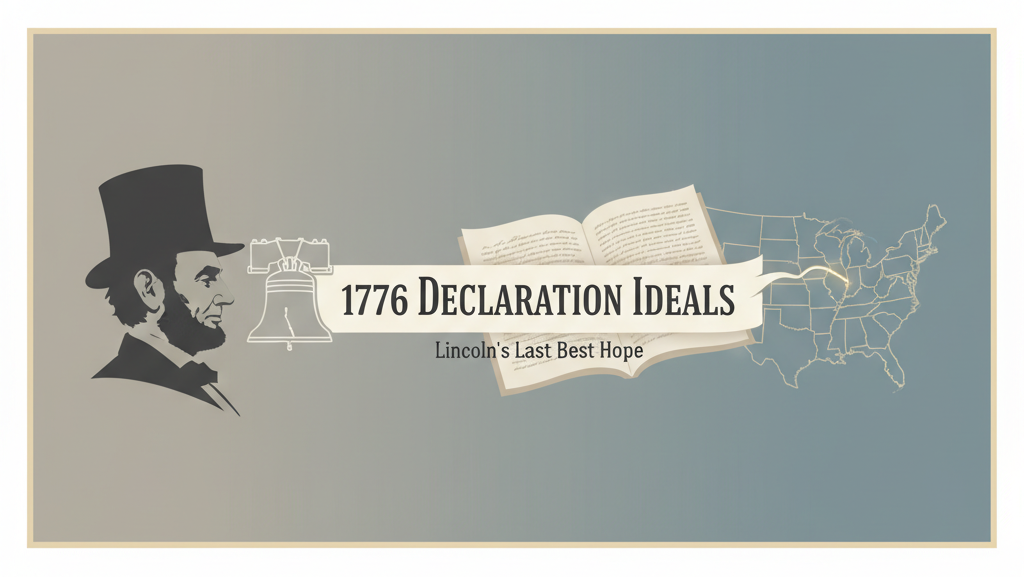
Lincoln's Last Best Hope: Civil War Ties to 1776 Declaration Ideals
In the midst of a nation fractured by civil strife, Abraham Lincoln articulated a profound vision for America during his Gettysburg Address. He described the United States as "the last best hope of earth," a sentiment deeply rooted in the ideals outlined in the Declaration of Independence. This connection between Lincoln's resolve and the revolutionary principles of 1776 is crucial for understanding the moral compass that guided the nation through its darkest hour.
Key Takeaways
- Abraham Lincoln viewed the American Civil War as a test of the nation’s commitment to liberty and equality.
- Lincoln’s "last best hope of earth" phrase connects directly to the Declaration’s assertion of unalienable rights.
- The Civil War was not only a political conflict but also a moral struggle to fulfill the promises of the Declaration.
- Lincoln’s speeches often invoked the founding principles, emphasizing the need for a government that protects individual rights.
- The ideals of 1776 served as a philosophical foundation for Lincoln’s vision of a unified nation post-war.
- Lincoln believed that the survival of democracy depended on the outcome of the Civil War.
- The legacy of the Civil War and Lincoln's leadership is a continuing dialogue around freedom and equality in America.
The Civil War: A Test of American Ideals
Lincoln was acutely aware that the Civil War was about more than just states' rights or economic interests. It was a battle for the soul of the nation, a test of whether a government "of the people, by the people, for the people" could endure. This notion echoed the Declaration of Independence, which proclaimed that all men are created equal and endowed with rights that cannot be taken away.
In his speeches, Lincoln frequently referenced the Declaration's ideals. He understood that the war was an opportunity to not only preserve the Union but to redefine it. The Emancipation Proclamation was a direct reflection of this. By declaring that all slaves in the rebellious states were to be freed, Lincoln aligned the war effort with the foundational ideals of equality and freedom.
Lincoln's Vision and the Declaration
Lincoln’s vision extended beyond the immediate challenges of war. He saw the conflict as a pivotal moment to realize the promise of the Declaration. His famous phrase, "the last best hope of earth," suggested that the world was watching. The outcome of the American experiment would have global ramifications, affirming the idea that democracy could prevail over despotism.
The Declaration of Independence was not merely a historical document for Lincoln; it was a living manifesto that demanded active engagement. He believed that the Civil War was a chance to recommit to the principles of liberty and justice, not just for Americans, but as a beacon for oppressed peoples worldwide.
Moral Struggle and Redemption
Lincoln's rhetoric reflected a deep moral struggle, one that resonated with the American ethos. He articulated a vision of a nation that could emerge from the war not just intact, but transformed. In his Second Inaugural Address, he famously stated that the war might be God's punishment for the sin of slavery. This acknowledgment of a national moral failing and the call for reconciliation illustrated his commitment to healing both the land and the people.
This moral dimension of Lincoln's leadership was crucial. It wasn't enough to win the war; the nation had to grapple with its conscience. The ideals of the Declaration were not just abstract concepts; they demanded real-world application. Lincoln’s leadership aimed to ensure that the sacrifices made during the Civil War would lead to a broader understanding of freedom, extending it beyond just the Union to encompass all Americans.
Legacy of Lincoln and the Declaration
The legacy of the Civil War and Lincoln's leadership continues to shape discussions around freedom and equality in America. The ideals laid out in the Declaration of Independence remain a standard against which the nation is measured. Lincoln's belief that America was "the last best hope of earth" serves as a reminder of the ongoing struggle to fulfill the promises made in 1776.
As we reflect on Lincoln's vision, it becomes clear that the connection between the Civil War and the Declaration is not merely historical; it is a call to action for future generations. The ideals of liberty, equality, and justice are as relevant today as they were in Lincoln's time. The challenge remains: how do we continue to strive towards that vision of a united nation truly embodying the principles of the Declaration?
Conclusion
Abraham Lincoln’s articulation of America as "the last best hope of earth" is a powerful reminder of the enduring nature of the principles enshrined in the Declaration of Independence. As we navigate contemporary challenges, we must remember that the fight for equality and justice is ongoing. Lincoln’s vision compels us to reflect on our role in this narrative and to work tirelessly to ensure that the ideals of 1776 remain alive and relevant in our society.