How AI Is Actually Changing Everyday Life
By Joel Burns on June 25, 2026
Artificial intelligence often feels like something from the future. News headlines talk about advanced chatbots, self-driving cars, and machines that can generate images, write code, or even pass professional exams.
Yet for most people, AI isn’t a future technology anymore—it’s already part of everyday life.
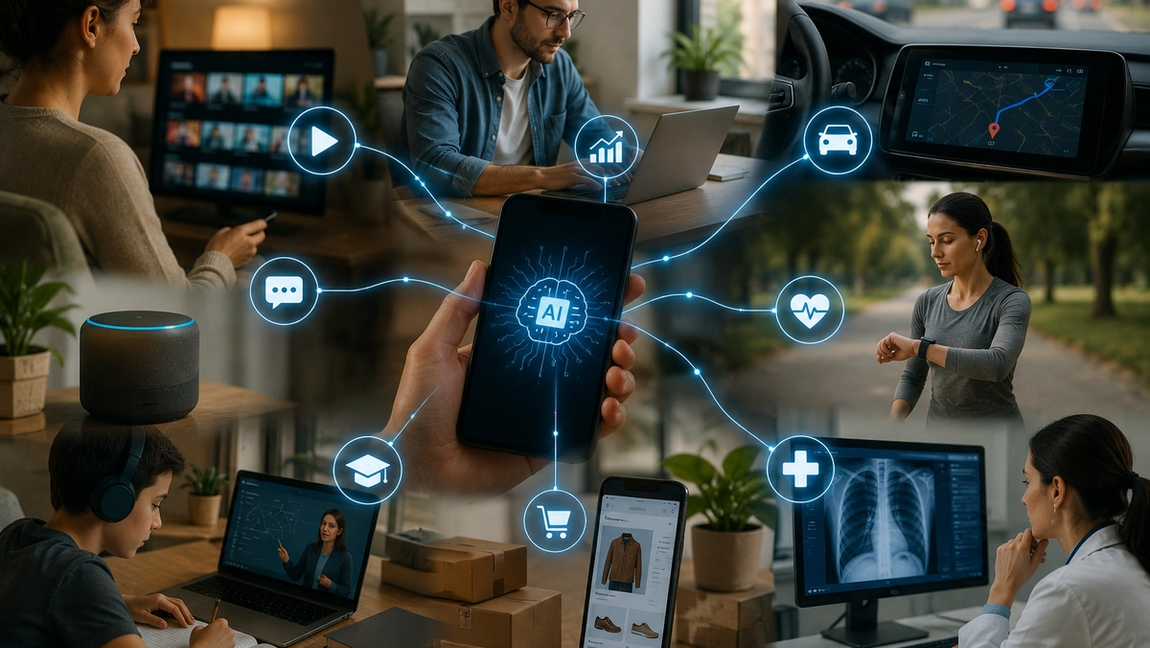
In many cases, we interact with artificial intelligence dozens of times a day without even realizing it. From the phones in our pockets to the apps we use and the services we rely on, AI is quietly working behind the scenes to make technology faster, smarter, and more personalized.
AI is making our devices smarter
One of the most common ways people experience AI is through their smartphones.
When your phone automatically recognizes faces in photos, suggests replies to messages, filters spam calls, improves image quality, or predicts the next word you’re about to type, artificial intelligence is usually involved.
Modern smartphones use AI to process enormous amounts of information in real time. This allows devices to understand patterns, recognize speech, and perform tasks that once required significant human effort.
Many features that now feel ordinary would have seemed remarkably advanced just a decade ago.
Search and recommendations are becoming more personalized
Every time you search for information online, AI helps determine which results appear first.
Streaming services use AI to recommend movies and shows based on your viewing history. Music platforms suggest songs you might enjoy. Online stores recommend products that match your interests.
These systems analyze large amounts of data to identify patterns and make predictions about what users are most likely to find useful or interesting.
While recommendations aren’t always perfect, they have fundamentally changed how people discover content, products, and information.
AI is changing how people work
For many professionals, AI has become a productivity tool.
Writers use it to brainstorm ideas and improve drafts. Designers use it to generate concepts. Programmers use it to assist with coding. Customer service teams use AI-powered chat systems to answer routine questions.
Rather than replacing every human task, today’s AI often acts as a helper that speeds up repetitive or time-consuming work.
This allows people to focus more of their attention on creativity, strategy, decision-making, and problem-solving.
As AI tools continue to improve, they are becoming as common in workplaces as spreadsheets and email once did.
Navigation and transportation rely heavily on AI
Most people use AI whenever they open a navigation app.
Traffic predictions, route recommendations, estimated arrival times, and real-time rerouting all depend on systems that analyze massive amounts of data.
Ride-sharing services also use AI to match drivers with passengers, predict demand, and optimize routes.
Even modern vehicles increasingly rely on AI-powered features such as lane assistance, adaptive cruise control, parking assistance, and collision detection systems.
While fully autonomous vehicles remain a work in progress, artificial intelligence is already making transportation safer and more efficient.
Healthcare is becoming more data-driven
Artificial intelligence is also playing an increasing role in healthcare.
Doctors and researchers use AI to help analyze medical images, identify patterns in health data, support diagnosis, and accelerate scientific research.
AI can process vast amounts of information much faster than humans, helping healthcare professionals make more informed decisions.
Importantly, these systems are generally designed to assist rather than replace medical experts. Human judgment remains essential, particularly when dealing with complex cases and patient care.
As technology advances, AI is likely to become an even more valuable tool within healthcare systems worldwide.
AI is changing education and learning
Learning has become more accessible thanks to AI-powered tools.
Students can receive personalized explanations, language-learning assistance, writing feedback, and tutoring support whenever they need it. Educational platforms increasingly adapt lessons based on a learner’s progress and strengths.
This flexibility allows people to learn at their own pace and access educational resources that were once difficult to obtain.
For many learners, AI functions as an always-available assistant that helps answer questions and clarify concepts.
Concerns and challenges remain
While AI offers many benefits, it also raises important questions.
Concerns about privacy, misinformation, bias, job displacement, and the ethical use of artificial intelligence continue to be widely discussed. Like any powerful technology, AI can be used in both helpful and harmful ways.
The challenge for governments, businesses, and society is ensuring that AI develops responsibly while maximizing its benefits.
As adoption grows, conversations about transparency, accountability, and regulation are likely to become increasingly important.
The future is already here
When people imagine artificial intelligence, they often think about futuristic robots or science-fiction scenarios.
In reality, AI’s biggest impact may be far less dramatic. It is quietly improving search results, recommending music, helping doctors analyze data, guiding navigation systems, assisting workers, and making everyday technology easier to use.
Most of these changes happen in the background, which is why many people don’t notice them.
The truth is that artificial intelligence is already changing everyday life—not through a single revolutionary moment, but through thousands of small improvements that have gradually become part of how we live, work, learn, and communicate.