The Art of Doing Less and Getting More
By Emma Felix on June 25, 2026
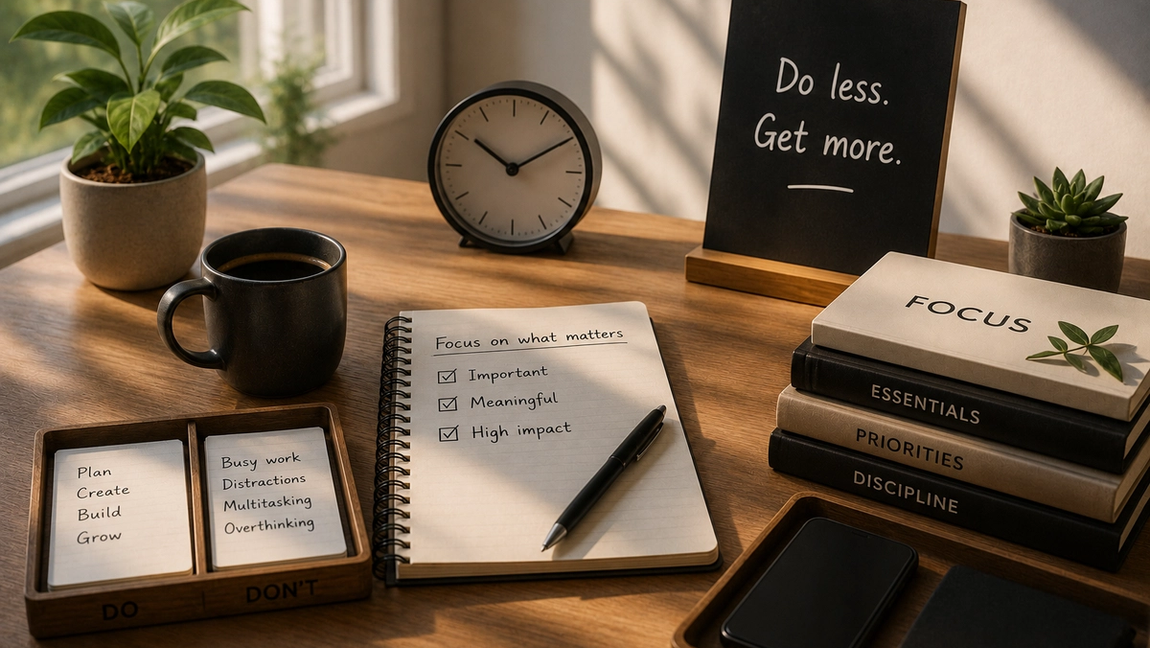
Modern life often rewards busyness. Packed calendars, overflowing inboxes, and endless to-do lists are frequently treated as signs of productivity and success. Yet many people reach the end of the day feeling exhausted while wondering what they actually accomplished.
The problem is that being busy and being productive are not the same thing. In many cases, doing more simply creates more distractions, more stress, and less meaningful progress. The people who consistently achieve important goals often aren’t the ones doing the most—they’re the ones focusing on the right things.
The art of doing less and getting more is about directing your energy toward what matters most and letting go of what doesn’t.
Focus on the vital few
Not all tasks create equal results.
A small number of activities usually produce the majority of meaningful outcomes in our work and personal lives. Yet many people spend their days treating every task as equally important.
Answering emails, attending meetings, organizing files, and checking notifications can create the feeling of productivity without necessarily moving important goals forward.
Instead of asking, “What do I need to do today?” try asking, “What will make the biggest difference today?”
Focusing on a few high-impact tasks often produces better results than attempting to complete dozens of smaller ones.
Stop confusing activity with progress
It’s easy to mistake motion for movement.
Crossing items off a checklist feels satisfying, but not all completed tasks contribute equally to your goals. Sometimes the most important work is also the least visible: writing a proposal, learning a new skill, having a difficult conversation, or making a strategic decision.
These activities may take more effort and produce fewer immediate rewards, but they often create the greatest long-term impact.
Productive people understand that progress isn’t measured by how busy they look. It’s measured by whether they’re moving closer to what matters.
Learn to say no more often
Every commitment comes with a cost.
When you say yes to one project, meeting, invitation, or responsibility, you’re also saying no to something else—whether that’s focused work, personal time, rest, or family.
Many people become overwhelmed not because they lack time, but because they have too many competing priorities.
Learning to say no doesn’t mean becoming unhelpful or selfish. It means recognizing that your time and energy are limited resources.
Often, the fastest way to create space for what matters is not by working harder, but by removing unnecessary commitments.
Create room for deep work
Constant interruptions make meaningful work difficult.
Notifications, messages, emails, and social media updates can fragment attention throughout the day. Even brief distractions often require time to recover from mentally.
People who accomplish a great deal tend to protect periods of uninterrupted focus. During these periods, they concentrate on one task rather than switching between multiple activities.
This kind of focused work often produces higher-quality results in less time than multitasking.
The ability to concentrate deeply is becoming increasingly valuable in a world designed to compete for attention.
Simplify your decisions
Decision fatigue is real.
Every choice you make throughout the day consumes mental energy. While individual decisions may seem small, hundreds of them can add up quickly.
Many highly effective people simplify routine parts of their lives whenever possible. They establish habits, systems, and routines that reduce the number of decisions they need to make daily.
Simple practices such as planning tomorrow’s priorities the night before, preparing meals in advance, or creating consistent routines can free up mental energy for more important matters.
Less time spent deciding means more time spent doing.
Embrace the power of rest
Many people treat rest as something to earn after all the work is finished.
The reality is that the work is rarely finished. There will always be another email, another project, another responsibility waiting.
Rest isn’t the opposite of productivity—it supports it.
Sleep, exercise, breaks, hobbies, and time with loved ones help maintain energy, creativity, and focus. Without recovery, performance eventually declines no matter how hard you work.
People who consistently perform at a high level understand that sustainable success requires periods of renewal.
Doing less sometimes means creating space to recover so you can do better work later.
Measure success differently
One reason people struggle to do less is that society often celebrates visible effort.
Long hours, packed schedules, and constant availability can look impressive from the outside. Yet they don’t always lead to better results.
Instead of measuring success by how much you do, consider measuring it by the value you create, the goals you achieve, or the quality of your work.
A shorter to-do list completed thoughtfully can often be more valuable than a long list completed hurriedly.
The goal is not to maximize activity. It’s to maximize impact.
Less can truly be more
The idea of doing less may sound counterintuitive in a culture that constantly encourages more. More work, more goals, more commitments, and more productivity.
Yet many of the most effective people understand a simple truth: success often comes from eliminating the unnecessary rather than adding more.
By focusing on the vital few, protecting your attention, simplifying decisions, and creating space for rest, you can accomplish more without feeling constantly overwhelmed.
The art of doing less and getting more isn’t about lowering your ambitions. It’s about making sure your time, energy, and effort are spent on the things that truly matter.