The Inventions That Changed How We Live (And Why)
By Jamal Ware on June 25, 2026
It’s easy to take modern life for granted. We flip a switch and expect light. We send a message across the world in seconds. We travel hundreds of miles in a matter of hours and carry powerful computers in our pockets.
Behind all of these conveniences are inventions that fundamentally changed how people live, work, communicate, and interact with the world. Some of these innovations were revolutionary from the moment they appeared, while others took decades to reveal their full impact.
What makes an invention truly transformative isn’t just that it solves a problem—it’s that it changes everyday life for millions or even billions of people.
The printing press: Making knowledge accessible
Before the printing press, books had to be copied by hand, making them expensive, rare, and accessible to only a small portion of society.
In the mid-15th century, Johannes Gutenberg introduced a movable-type printing press that dramatically increased the speed and efficiency of producing written materials.
For the first time, books could be distributed on a large scale. Knowledge spread more quickly, literacy rates increased, and ideas could reach far larger audiences.
The printing press helped accelerate education, science, religion, and political change. Many historians consider it one of the most influential inventions in human history because it transformed how information was shared.
Electricity: Powering the modern world
Few inventions have had a greater impact on daily life than the practical use of electricity.
Electricity made it possible to illuminate homes and streets, power factories, operate appliances, and eventually support everything from computers to smartphones.
Inventors and scientists such as Thomas Edison, Nikola Tesla, and many others contributed to the development of electrical systems that changed society forever.
Today, nearly every aspect of modern life depends on reliable electrical power. Without it, much of the technology we use every day simply would not exist.
The automobile: Redefining mobility
Before automobiles became common, most people traveled on foot, horseback, or by train.
The development of affordable cars transformed transportation by giving individuals unprecedented freedom of movement. People could live farther from where they worked, travel more easily, and access opportunities that were previously out of reach.
The automobile also reshaped cities, economies, and entire industries. Roads, gas stations, logistics networks, and suburban communities all developed in response to widespread vehicle ownership.
While transportation continues to evolve today, the automobile remains one of the inventions that most dramatically changed everyday life.
The airplane: Shrinking the world
For most of human history, long-distance travel required weeks or even months.
The invention of powered flight changed that reality. What once seemed impossible became routine within a relatively short period of time.
Air travel connected countries, cultures, and economies in ways never before possible. International tourism expanded, global business became easier, and families separated by great distances could remain connected.
The world didn’t physically become smaller, but it became much more accessible.
Today, millions of people travel by air every day, often crossing continents in less time than previous generations needed to travel between neighboring regions.
The internet: Connecting the world
If one invention has defined the modern era, it may be the internet.
Originally developed as a way to connect computer networks, the internet evolved into a global communication system that influences nearly every aspect of daily life.
People can now access information instantly, communicate across continents, work remotely, shop online, stream entertainment, and learn new skills from virtually anywhere.
The internet has transformed industries, education, healthcare, business, and social interactions. Its influence is so extensive that it’s difficult to imagine modern society without it.
Few inventions have affected as many areas of life as quickly as the internet has.
The smartphone: A computer in your pocket
The smartphone combined multiple inventions into a single device.
It serves as a phone, camera, GPS navigator, music player, internet browser, calculator, flashlight, gaming device, and much more.
What makes smartphones remarkable isn’t just their technology but their accessibility. Billions of people carry one every day, giving them instant access to information, communication, and digital services.
Tasks that once required multiple devices—or even multiple locations—can now be completed from almost anywhere.
The smartphone has changed how people communicate, consume information, work, travel, and spend their free time.
Why some inventions matter more than others
Thousands of inventions appear every year, but only a few fundamentally reshape society.
The inventions that have the greatest impact tend to share certain qualities. They solve important problems, become widely accessible, and create new possibilities that extend far beyond their original purpose.
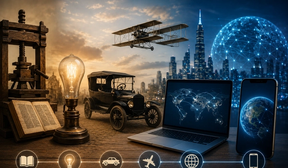
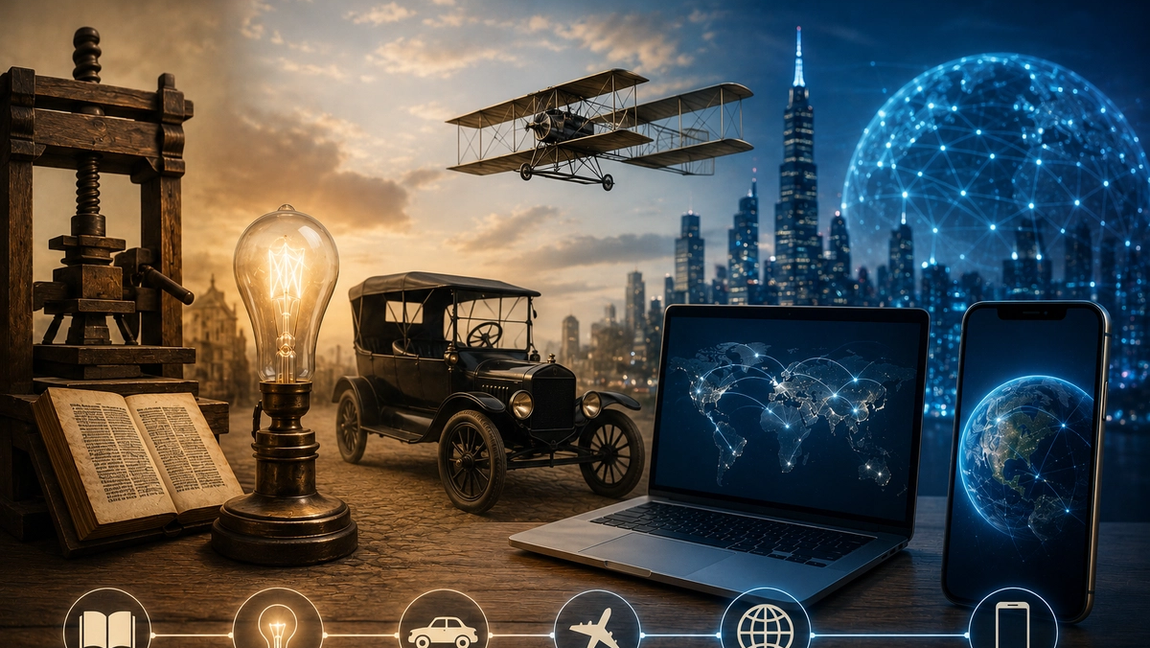
The printing press made knowledge more available. Electricity powered modern civilization. Automobiles and airplanes transformed transportation. The internet connected the world, and smartphones placed that connection into people’s hands.
These innovations didn’t simply improve existing systems—they changed how people lived.
The next great invention
History shows that transformative inventions often seem ordinary at first.
Few people could have predicted how profoundly electricity, automobiles, or the internet would influence daily life. The same may be true of technologies being developed today, including artificial intelligence, advanced renewable energy systems, biotechnology, and new forms of computing.
No one knows exactly which invention will define the next century.
What history makes clear, however, is that a single breakthrough can alter the way billions of people live, work, and interact with the world. The inventions we now consider ordinary were once unimaginable—and the next life-changing innovation may already be taking shape today.