The Books Worth Reading Twice
By Emma Felix on June 25, 2026
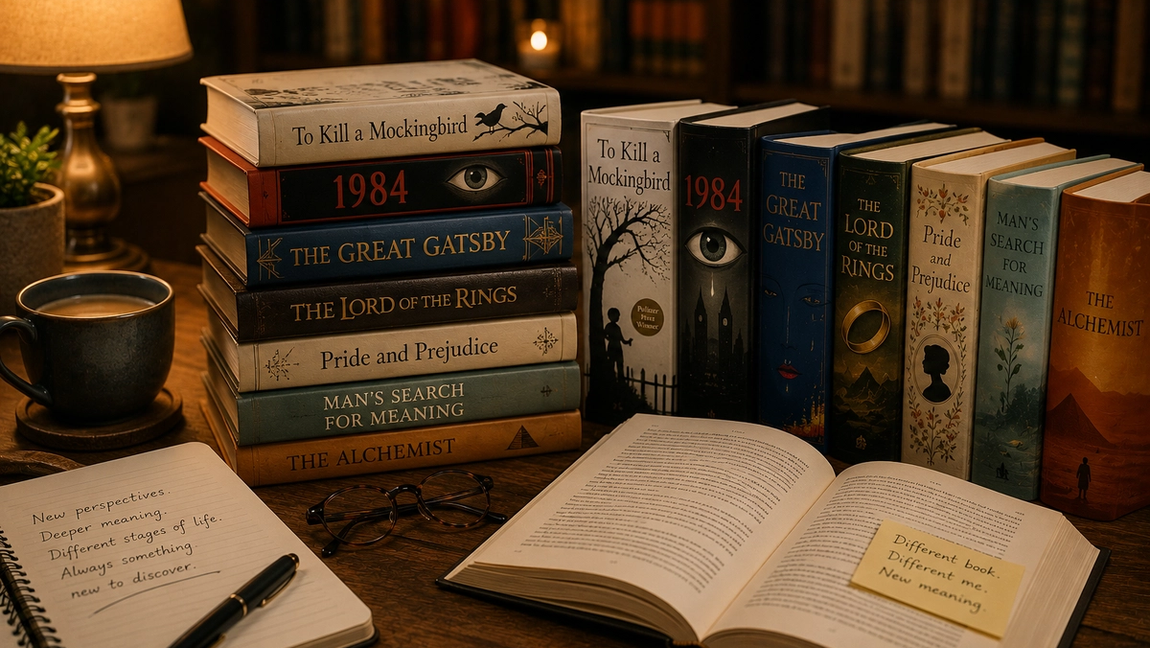
Most books are read once and then placed back on a shelf, donated, or forgotten entirely. There’s nothing wrong with that. Many books provide entertainment, information, or inspiration exactly when we need them.
But some books are different.
They reveal new layers each time you return to them. You notice details you missed, interpret characters differently, or discover ideas that resonate more deeply because you’ve changed since the first reading. In many cases, the second reading is even more rewarding than the first.
A truly great book doesn’t just tell a story—it grows with the reader.
Why some books deserve a second reading
The first time you read a book, much of your attention is focused on finding out what happens next.
You’re following the plot, learning about the characters, and trying to understand the world the author has created. During a second reading, that pressure disappears.
You already know the destination.
As a result, you can pay closer attention to the writing, symbolism, themes, and subtle details that may have gone unnoticed before. You begin to appreciate not just the story itself but how the story is told.
The best books often reward that deeper level of attention.
To Kill a Mockingbird
To Kill a Mockingbird is frequently assigned in schools, but it often feels very different when revisited as an adult.
A first reading may focus on the story through the eyes of Scout. A second reading often highlights the moral courage of Atticus, the social dynamics of the community, and the broader themes of justice, empathy, and prejudice.
Many readers find that the book becomes more powerful as their understanding of the world expands.
Its lessons remain remarkably relevant decades after publication.
1984
1984 is one of those rare novels that can feel different every time you read it.
On the first read, it’s often experienced as a gripping dystopian story. Later readings tend to reveal more about language, propaganda, surveillance, power, and the ways societies shape truth.
Many readers are surprised by how many details they overlooked the first time.
Its themes continue to spark discussion because they remain unsettlingly relevant.
The Great Gatsby
Few novels benefit from rereading as much as The Great Gatsby.
When read young, it can seem like a story about wealth, romance, and ambition. Later in life, readers often notice themes of illusion, longing, identity, and the pursuit of unattainable dreams.
The novel is also filled with symbolism and carefully crafted details that are easy to miss during a first reading.
Its relatively short length makes it particularly rewarding to revisit.
The Lord of the Rings
Many readers return to The Lord of the Rings multiple times throughout their lives.
The first reading is often an adventure. Subsequent readings reveal the depth of its world-building, mythology, languages, themes of friendship, sacrifice, and resilience.
Each journey through Middle-earth tends to uncover something new.
The richness of the world created by J. R. R. Tolkien is one reason the books continue to attract readers generations after their publication.
Pride and Prejudice
Pride and Prejudice is often remembered for its romance, but rereading reveals how sharp and insightful it truly is.
Its observations about social expectations, class, family dynamics, and human behavior remain surprisingly modern.
Many readers appreciate the humor and wit more deeply on subsequent readings because they are no longer focused solely on the central love story.
It’s a novel that rewards attention to character and dialogue.
Man’s Search for Meaning
Man’s Search for Meaning is one of those books that often feels different depending on where you are in life.
The book combines the author’s experiences in Nazi concentration camps with reflections on purpose, resilience, and meaning.
Readers frequently return to it during different stages of life and find new insights each time.
Its message about finding meaning even during difficult circumstances continues to resonate with millions of people worldwide.
The Alchemist
The Alchemist is another book that many readers revisit.
Its simple story and philosophical themes allow different lessons to emerge depending on your age, experiences, and perspective.
What feels inspiring in your twenties may feel entirely different in your forties or fifties.
The book’s enduring popularity stems partly from its ability to speak to readers at different moments in their lives.
The best rereads change because you change
One of the most fascinating aspects of rereading is that the book itself stays the same while the reader changes.
Life experience alters how we interpret characters, relationships, success, failure, love, ambition, and loss. A passage that seemed insignificant years ago may suddenly feel profound.
This is why some books remain meaningful throughout a lifetime.
They continue to offer new perspectives because we bring new perspectives to them.
A great book is never truly finished
The books worth reading twice—or even three or four times—are usually the ones that continue to reveal something new.
They contain layers that weren’t immediately obvious, characters who feel increasingly complex, or ideas that become more relevant as life unfolds.
Not every book needs a second reading. But the truly exceptional ones often reward the effort.
A great book doesn’t simply tell a story once. It invites you back, offering a different experience each time you return. And that may be one of the clearest signs that it was worth reading in the first place.