The Ideas That Sounded Crazy and Turned Out Right
By Emma Felix on June 25, 2026
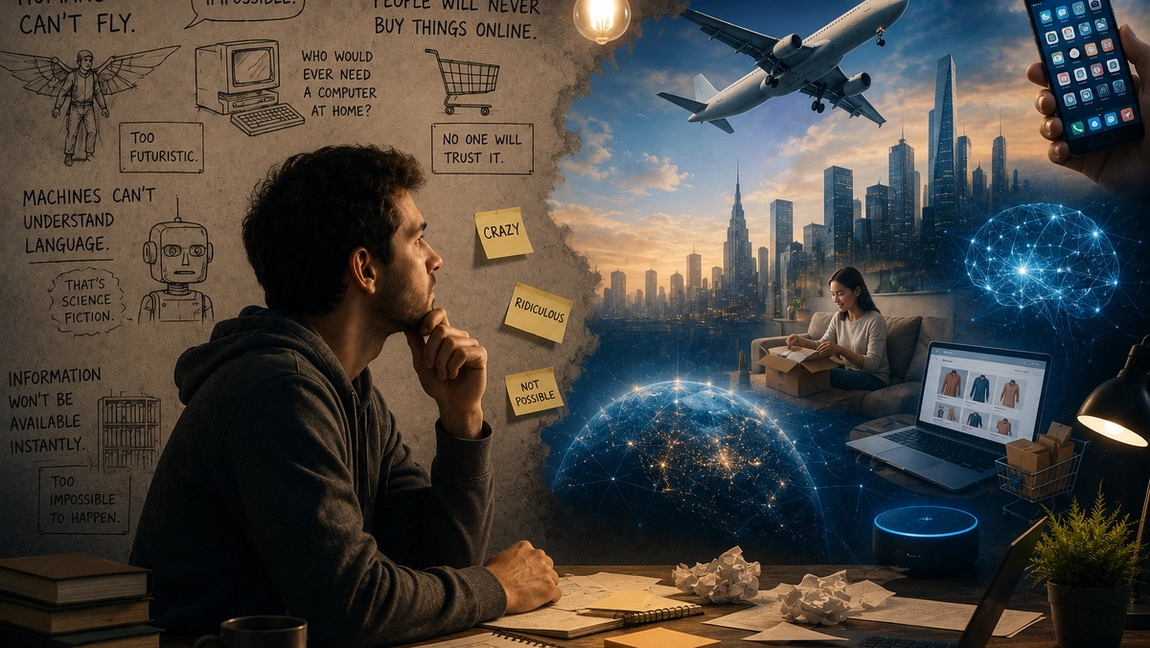
History is filled with ideas that were dismissed, mocked, or considered impossible—until they changed the world.
Many of the technologies and discoveries we take for granted today were once viewed as unrealistic, dangerous, or simply ridiculous. Experts doubted them. Investors rejected them. Critics laughed at them.
This doesn’t mean every unconventional idea is destined for success. Most aren’t. But history reminds us that groundbreaking ideas often look unreasonable before they become obvious.
The challenge is that truly transformative ideas tend to challenge existing assumptions, and people are naturally skeptical of things that seem too different from what they already know.
The idea that humans could fly
For centuries, human flight was considered a fantasy.
People observed birds and dreamed about flying, but many believed it would never be possible for humans. Even as inventors experimented with various flying machines, the idea remained largely in the realm of imagination.
That changed in 1903 when Orville Wright and Wilbur Wright successfully achieved powered flight.
Today, air travel connects countries, supports global commerce, and allows millions of people to cross continents in hours. What once seemed impossible is now routine.
The idea that everyone would carry a computer
A few decades ago, computers were large, expensive machines found mainly in businesses, universities, and government institutions.
The idea that billions of people would carry powerful computers in their pockets sounded unrealistic. Even many technology experts underestimated how important mobile computing would become.
Today, smartphones provide communication, navigation, photography, entertainment, banking, shopping, and access to vast amounts of information from virtually anywhere.
What once sounded futuristic has become an ordinary part of daily life.
The idea that people would shop online
In the early days of the internet, many people were reluctant to enter their credit card details online.
The thought of purchasing products from a website without seeing them in person felt risky and unfamiliar. Critics questioned whether consumers would ever trust online shopping enough for it to become mainstream.
Today, e-commerce is a major part of the global economy. Consumers routinely order everything from groceries to furniture with a few taps on a screen.
What seemed inconvenient or unsafe to many people eventually became one of the most common ways to shop.
The idea that machines could understand language
For much of computer history, machines could only follow highly structured instructions.
The idea that a computer could understand questions, generate text, translate languages, or hold conversations sounded like science fiction.
Advances in artificial intelligence have changed that dramatically. Modern AI systems can assist with writing, research, coding, customer service, education, and countless other tasks.
While AI still has limitations, the idea that computers could communicate using natural language no longer seems strange. It’s becoming increasingly common.
The idea that information could be available instantly
Before the internet, finding information often required visiting a library, consulting reference materials, or speaking with experts.
The notion that nearly all human knowledge could be accessible from a small device in seconds would have sounded extraordinary.
Today, people expect instant access to news, directions, educational resources, and answers to everyday questions.
The speed at which information can now be found has transformed education, business, communication, and decision-making around the world.
Why revolutionary ideas often face resistance
New ideas frequently encounter skepticism because they challenge established beliefs.
People tend to evaluate future possibilities using current limitations. If something has never been done before, it can be difficult to imagine how it might eventually work.
There are also practical reasons for resistance. Existing industries, habits, and investments are often built around the status quo. Change can feel risky, especially when outcomes are uncertain.
As a result, many important innovations spend years being questioned before gaining acceptance.
This pattern has repeated itself throughout history.
Not every crazy idea succeeds
It’s important to remember that being unconventional is not enough.
History celebrates successful ideas that seemed impossible, but countless unrealistic ideas failed as well. The fact that an idea is unusual does not automatically make it valuable.
Successful innovations generally solve real problems, create meaningful value, and become practical enough for widespread adoption.
The difference between a breakthrough and a bad idea often becomes clear only with time.
That’s one reason predicting the future is so difficult.
Today’s impossible ideas may be tomorrow’s reality
Many technologies currently being developed still sound unbelievable to some people.
Advances in artificial intelligence, renewable energy, biotechnology, robotics, and space exploration may eventually reshape society in ways that are difficult to imagine today.
Some of these ideas will fail. Others may transform entire industries.
History suggests that the future often arrives in ways that initially seem unrealistic. The inventions and innovations that define one generation are frequently the same ideas that previous generations dismissed.
That’s why it’s worth keeping an open mind. Some of the ideas that sound crazy today may eventually become the things we can no longer imagine living without.